

Guide Roller Coatings: Balancing Wear Resistance and Surface Contact
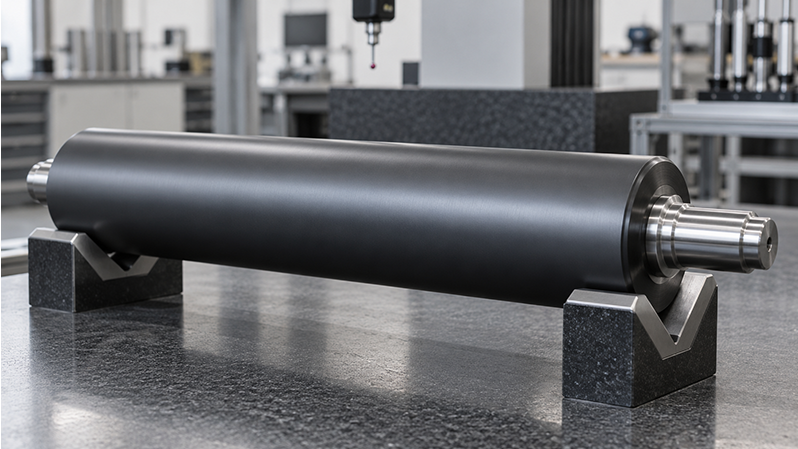
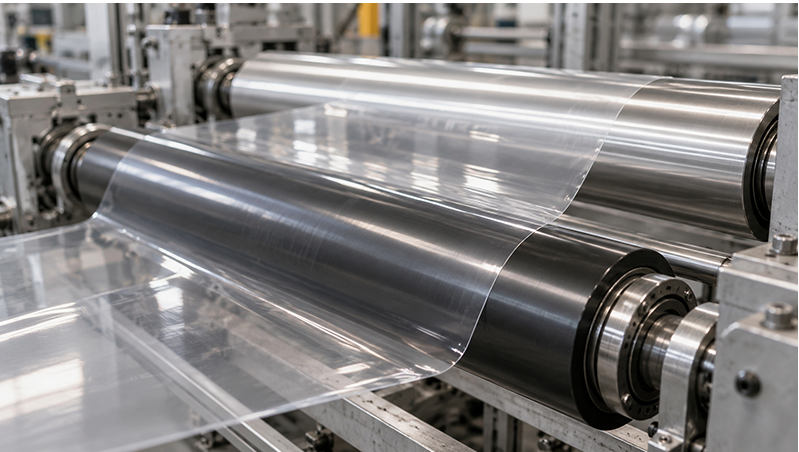
This creates two connected requirements. The roller must resist wear, and its working surface must maintain suitable contact with the product. A hard coating alone does not define that balance. Surface texture, friction, adhesion and the condition of the underlying roller also matter.
For manufacturers planning in-house coating production, the first step is to define what the roller surface must do. Equipment selection should follow those requirements.
1. Define the Roller’s Contact Function
“Guide roller” describes a role in a production line, but individual rollers can operate under different contact conditions. Some redirect a moving web. Others help maintain its path or work close to sections where tension changes.
Before specifying a guide roller coating, establish:
The material touching the roller, including any existing surface treatment.
Whether the roller is driven or rotates freely.
Line speed, web tension and wrap angle.
The presence of sliding during startup, stopping or normal operation.
Permitted marks, scratches and contamination on the finished product.
Exposure to moisture, process residues and cleaning chemicals.
These details help explain why a surface fails. A roller showing longitudinal scratches requires a different investigation from one that stays smooth but allows unstable material movement.
The coating specification should describe both the roller’s durability target and the acceptable condition of the material after contact.
2. Identify What Is Causing Wear
Wear is often described as a single problem, although the visible damage can develop through several routes.
Hard particles trapped at the contact interface may produce abrasive tracks. Material transferred onto the roller can build raised deposits that repeatedly mark the passing web. Local sliding may change the surface texture in particular areas.
Inspect the roller across its working width and around its circumference. Record where damage starts, how it develops and when it first becomes visible in the product.
Useful evidence includes photographs of worn surfaces, samples of defective material, cleaning records and the operating conditions associated with each failure.
For example, marks appearing immediately after a cleaning operation should prompt a review of the cleaning method. Damage concentrated near one edge should also trigger checks of alignment and loading.
Wear-resistant roller coatings should address a verified surface problem. Coating selection cannot replace investigation of bearing condition, alignment, trapped particles or mechanical damage.
3. Specify the Finished Surface, Not Just Coating Hardness
For a guide roller contacting sensitive material, surface finish belongs in the acceptance criteria from the beginning.
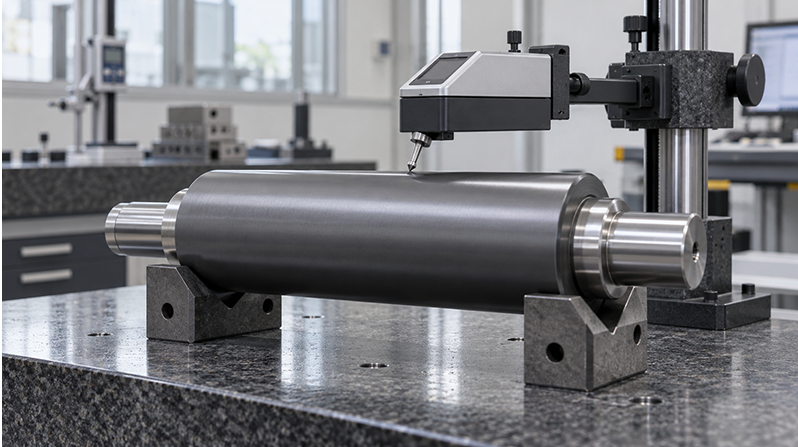
Average roughness, commonly expressed as Ra, is useful, but it does not describe every surface feature. Local peaks, scratches and isolated defects can matter even when the average measurement appears acceptable.
A practical specification should identify:
Required roughness after coating and any approved finishing.
Measurement positions across the roller face.
Measurement direction and a consistent inspection method.
Limits for visible scratches, raised defects and edge damage.
Product contact requirements confirmed through a representative trial.
4. Set the Friction Requirement Around Material Transport
Lower friction can be valuable where unwanted sliding and material pickup contribute to wear. However, “the lowest possible friction” is an incomplete specification for a guide roller.
The roller still needs appropriate interaction with the moving material. A freely rotating roller depends on contact forces to accelerate and follow the web. A driven roller may have a more demanding traction requirement.
For this reason, evaluate friction together with line behavior. Observe startup, acceleration, steady operation and stopping. Check for slipping, tracking changes and new surface marks.
The relevant question is:
Does this surface provide stable transport while limiting damaging contact?
Laboratory friction measurements help compare coating candidates, but their test conditions must be recorded. The counterface, applied load and lubrication conditions influence how useful a result is for the actual application. Representative testing is central to application-specific coating selection.
5. Evaluate DLC as a Candidate Coating
Diamond-like carbon, or DLC, is a coating family used in applications requiring wear resistance and reduced friction. Its properties vary with coating composition and structure, so the term “DLC” should not be treated as one fixed performance specification.
For selected metallic guide rollers, DLC is worth evaluating when surface wear and sliding contact are important concerns. Qualification should still establish its compatibility with the actual web material, cleaning routine and operating environment.
Huasheng’s DLC1500 DLC coating equipment combines magnetron sputtering and PECVD technology. The published coating system is Cr/WC/a-C, with a typical coating thickness of 2–4 μm and a listed deposition temperature below 200°C. These are equipment and process reference values, not automatic acceptance limits for every guide roller.
The final process needs to account for the roller material, heat treatment, dimensional tolerances and required surface function.
Temperature compatibility also needs review for the complete workpiece. Attached components, existing treatments and assembly features can impose restrictions beyond those of the roller body.
6. Control Adhesion and Dimensional Changes
A coating needs adequate support from the substrate and a reliable interface with it. Surface contamination or unsuitable preparation can undermine an otherwise appropriate coating choice.
Before coating, define the incoming condition of the roller. Include material identification, hardness where relevant, existing coating condition and permitted surface defects.
Bearing seats, journals and other precision features may require masking. The drawing should clearly distinguish the working surface from areas that must remain uncoated.
Coating thickness also affects dimensions. For a cylindrical surface coated uniformly, the diameter increase is approximately twice the coating thickness. A 3 μm layer therefore adds approximately 6 μm to the diameter before any subsequent finishing.
That change may be small, but it still belongs in a precision roller’s tolerance assessment.
Adhesion testing should use an agreed method appropriate to the coating and substrate. Scratch and indentation methods provide different information; results need interpretation within the selected test procedure.
7. Match Coating Equipment to the Actual Roller
A successful process on a small sample does not establish that a complete roller can be coated with the same consistency.
Equipment review should include total roller length, working diameter, weight, support locations and the space required by fixtures. Shaft extensions and masking arrangements also affect the usable loading envelope.
Huasheng’s industrial roller coating solutions cover equipment selection, fixture and rotation planning, and process configuration around the roller and production requirements. The objective is to establish a repeatable manufacturing process for the customer’s parts.
When assessing capacity, use a proposed loading arrangement rather than chamber volume alone. Confirm that the working surface remains accessible to the deposition process and that supporting or masking features do not create unacceptable coverage differences.
For production planning, calculate output using qualified rollers per batch. Include preparation, loading, coating, cooling, unloading and inspection. A nominal cycle time does not represent the entire production workflow.
8. Validate the Roller and the Material It Touches
A useful validation plan checks both sides of the contact interface.
Start with the coated roller: inspect surface condition, thickness, roughness and adhesion using agreed methods. Confirm dimensional requirements before installation.
Then run a controlled production trial with representative material. Record operating speed, tension, temperature and cleaning conditions so the results can be compared meaningfully.
Assess the trial against practical questions:
Does the product show scratches, impressions or transferred residue?
Does the web remain stable during speed changes?
Where does material accumulate on the roller?
How does the surface change after cleaning?
What condition triggers maintenance or replacement?
Agree on the trial length and acceptance limits before testing. A brief run may reveal immediate marking but provide little evidence about long-term wear.
Avoid assigning a universal service-life improvement to the coating. The useful result is documented performance under the customer’s defined operating conditions.
Frequently Asked Questions
Is DLC suitable for every guide roller?
Suitability depends on the substrate, contact material, operating conditions and required friction behavior. Treat DLC as a candidate for evaluation, with acceptance based on both roller performance and product quality.
Should a guide roller have the smoothest possible surface?
The required finish depends on the contact function. Specify surface texture together with material transport and marking limits. An application trial should confirm that the selected finish works at the intended line conditions.
Can coating repair an already worn roller?
A thin functional coating should not be used as a substitute for restoring worn dimensions or correcting surface damage. Assess the roller’s condition and complete any necessary repair and preparation before coating.
Plan an In-House Guide Roller Coating Process
A suitable guide roller coating combines wear resistance with controlled surface contact. The specification should connect coating properties to measurable production requirements: acceptable product finish, stable transport and a defined maintenance interval.
Huasheng supplies vacuum coating equipment for manufacturers developing this capability in-house. To discuss an appropriate configuration, provide the roller drawing, substrate, dimensions, weight, current surface condition, contact material, operating conditions and planned production volume.
These details form the basis for evaluating the coating route, loading arrangement and equipment required for your guide rollers.
Guangdong Huasheng Nanotechnology
Guangdong Huasheng Nanotechnology
Legal Disclaimer:
EIN Presswire provides this news content "as is" without warranty of any kind. We do not accept any responsibility or liability for the accuracy, content, images, videos, licenses, completeness, legality, or reliability of the information contained in this article. If you have any complaints or copyright issues related to this article, kindly contact the author above.
